 SOVATA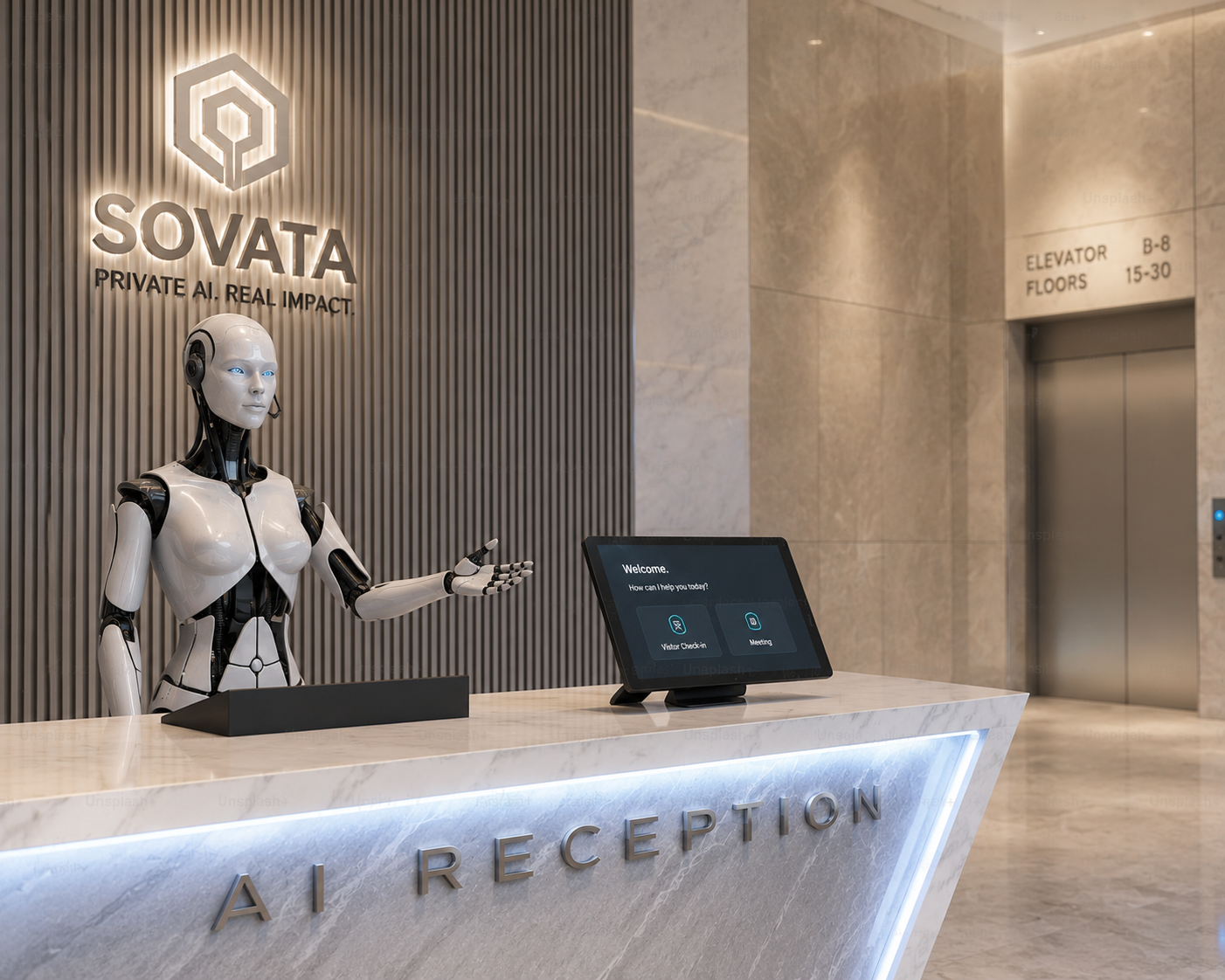

Last updated 22 July 2026
An AI receptionist is an AI system that answers your phone and web chat the way a good front-desk person would: it handles routine enquiries, takes messages, books appointments and passes anything important to a human — every hour of every day, so no caller ever lands in voicemail. It answers from your business’s approved information rather than a generic script, and it hands off to your team by rules you set.
What can an AI receptionist actually handle?
- After-hours and overflow calls — answered immediately instead of going to voicemail, which is where enquiries die.
- Routine questions — hours, services, pricing, directions — answered consistently from your approved information.
- Appointment bookings and rescheduling, written directly into your calendar or practice-management system.
- Message taking with real context: who called, why, and how urgent — not a transcription of a voicemail nobody checks.
- Triage — urgent or sensitive matters escalated to a person straight away, by rules you define.
What can’t it do? The honest limits
An AI receptionist should not give professional advice, handle a distressed or vulnerable caller alone, or bluff its way through a question it can’t answer confidently. The mark of a well-built system is that it knows its own boundary: it answers what it’s been approved to answer and hands everything else to a human quickly and gracefully. If a vendor demo never shows you the handoff, ask to see it — the handoff is the product.
Which businesses benefit most?
Any business that loses work to unanswered phones: law and accounting firms where a missed call is a missed client, medical and allied-health practices with heavy booking traffic, trades and construction businesses on site all day, and any front desk that spends hours a week answering the same twenty questions. The common thread is that the calls are valuable, frequent and mostly routine — exactly the shape of work AI handles well, with people reserved for the calls that matter.
What does an AI receptionist cost?
Two models exist. Offshore SaaS products typically charge per call or per minute — cheap to start, and the meter runs forever on infrastructure you don’t control. A privately deployed voice agent costs more to set up but runs at a fixed, predictable cost, and it’s built on your knowledge, your phone system and your escalation rules. Which is right depends on call volume and how sensitive your callers’ conversations are — for most professional practices, the sensitivity question decides it.
Why does it matter where a voice agent runs?
Because callers say sensitive things to receptionists — health details, legal matters, financial situations. Those calls become recordings and transcripts, and where that data is processed and stored is a professional-obligation question, not a technicality. A voice agent on a generic offshore platform routes caller conversations through infrastructure you don’t govern. A private deployment keeps conversations, transcripts and caller details inside a boundary you control, aligned with your Privacy Act 2020 obligations and your duty of confidentiality.
Frequently asked questions
They should — being upfront is both good practice and increasingly a legal expectation in many jurisdictions. A well-designed agent identifies itself, and callers who want a human get one without a fight. In practice, most callers care about getting their answer or booking quickly, not about who answered.
Modern speech models handle NZ English well, and a good deployment is tested against your real caller scenarios — local place names, Māori names and pronunciation, your industry’s terminology — before go-live. Where the system isn’t confident, it should hand off rather than guess.
The same governance as any AI deployment: it only answers from approved information, everything is logged and reviewable, and consequential matters route to a human. An AI receptionist that books a wrong time slot is an inconvenience you’ll catch in the log; one allowed to improvise advice is a liability — which is why boundaries are set before launch.
Ask any vendor for a live system you can call or chat with — not a video. The assistant on the Sovata website is built on the same stack we deploy for clients; testing it with hard questions is exactly what it’s there for.